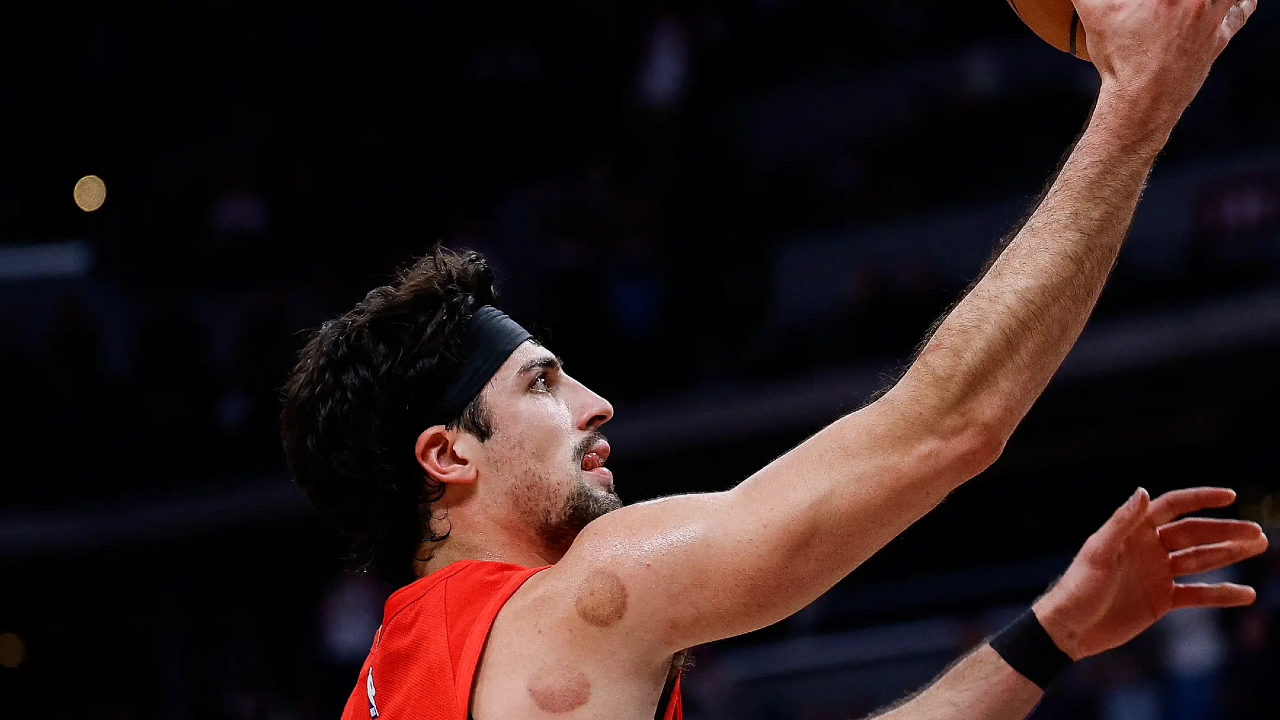
Deni Avdija led the way with 28 points, but it was Portland's collective effort that made the difference in a statement road win against the Nuggets.
There are plenty of ways to win a basketball game. Sometimes you have the best player on the floor. Sometimes you catch fire from three. And sometimes, you simply have more answers than the team standing across from you.
Monday night in Denver was a little bit of the latter.
The Portland Trail Blazers defeated the Denver Nuggets 118-110 at Ball Arena, overcoming an early 12-point deficit and a 13-attempt disadvantage at the free-throw line to secure one of their most impressive victories of the young season. Even more impressively, Portland snapped an 18-game losing streak in Denver.
This wasn't a game in which everything went according to plan. Portland struggled out of the gate, found itself playing catch-up, and had to make adjustments against one of the league's most talented offensive duos. But when it mattered, the Blazers found a way.
And that's what makes this win particularly encouraging.
Deni Avdija Is Becoming a Problem for Defenses
Let's start with Deni Avdija.
The Portland forward finished with 28 points, five assists, and three rebounds, including nine points in the fourth quarter. But the numbers don't entirely capture what makes his game so interesting.
When Deni is aggressive, he's one of the most difficult players in the league to keep out of the paint. He doesn't just settle for what's given to him. He actively looks for contact, attacks defenders, and seems almost determined to get himself to the free-throw line.
It's actually a little strange how much he appears to enjoy playing through contact.
If I were ranking the league's best slashers right now, my list would look something like this:
- Shai Gilgeous-Alexander
- Giannis Antetokounmpo
- Deni Avdija
- Anthony Edwards
- Cooper Flagg
That's how highly I think of his ability to put pressure on a defense.
Deni isn't necessarily going to shoot the lights out every night. He was just 2-of-9 from three against Denver. But that's almost beside the point. His ability to get downhill, create advantages, and force opposing defenses into difficult decisions is what makes him so valuable.
And when he's playing with that level of aggression, Portland becomes a much more dangerous basketball team.
Portland's Offense Has Multiple Gears
One of the things I particularly like about this Portland team is how it can play at different speeds.
At its best, this is a legitimate run-and-gun offense. The Blazers want to get out in transition, attack before the defense gets set, penetrate, and either finish at the rim or move the ball until somebody finds an opening.
It's an offense built around putting pressure on the defense rather than simply running through a predetermined set every possession.
But there's another dimension to this team that shouldn't be overlooked.
With Damian Lillard and Jrue Holiday in the backcourt, Portland has two experienced guards who understand how to slow things down when necessary. Not every possession needs to end in transition. Sometimes you need someone who can organize the offense, recognize a mismatch, make the right read, and get everyone into the right position.
That's where Holiday, in particular, becomes so important.
He finished with 17 points, eight rebounds, and 10 assists in just over 30 minutes. His stat line was impressive, but his overall impact went beyond that.
Holiday brings a level of composure that this team desperately needs. His fundamentals are sound on both ends of the floor, and defensively, he's still one of the most reliable guards you can put out there.
There's something reassuring about having a player like that on the floor. He doesn't need to force anything. He understands the game, makes the right decisions, and gives everyone around him a little more room to operate.
And that's exactly what Portland needed against Denver.
The Supporting Cast Deserves Its Flowers
If you're looking for the biggest individual performance of the night outside of Avdija, Donovan Clingan has a pretty good argument.
The big man finished with 17 points, 18 rebounds, three assists, and four blocks. That's an enormous contribution, particularly against a team featuring Nikola Jokic.
Clingan's presence on the glass gave Portland additional possessions, while his rim protection helped make life more difficult for Denver around the basket.
Chris Youngblood also provided valuable production off the bench, finishing with seven points. Sidy Cissoko added eight, while Robert Williams contributed six rebounds in limited minutes.
These aren't necessarily the names that are going to dominate the headlines, but they're exactly the types of contributions that help win games like this.
And then there's Toumani Camara.
I think we sometimes throw around the phrase "he can guard 1-5" a little too casually. It's become one of those basketball expressions that gets attached to practically every versatile wing in the league.
But Camara genuinely has a case.
He has the physical tools, lateral quickness, and defensive instincts to make life difficult for a variety of different players. He can switch, compete, and hold his own against different positions.
He finished with nine points and five rebounds, but his value to this team isn't going to be measured by his scoring totals.
Portland needs players like Camara. Players who can do a little bit of everything without needing the offense to revolve around them.
And with Holiday providing defensive leadership, Camara's versatility, and Clingan protecting the paint, this team has the makings of a pretty interesting defensive group.
Denver Had Its Stars. Portland Had Its Team.
To be fair, Denver didn't exactly get a poor performance from its two biggest stars.
Jamal Murray was outstanding, finishing with 35 points, five rebounds, and six assists while shooting 10-of-19 from the field and a perfect 11-of-11 from the free-throw line.
Jokic was Jokic, adding 26 points, nine rebounds, and eight assists.
The problem was what happened beyond them.
Aaron Gordon had a particularly disappointing evening, finishing with just five points on 2-of-6 shooting. DeMar DeRozan added nine points, but I would have liked to see him be considerably more aggressive.
He attempted just seven shots in 20 minutes.
I'm also not entirely convinced that the Jokic-DeRozan minutes are going to work as well as Denver might have envisioned. Their offensive tendencies don't necessarily complement one another, particularly when Murray is also on the floor.
I thought one of the benefits of bringing DeRozan off the bench was supposed to be giving Denver another player capable of creating offense when one of its primary stars wasn't on the court.
Instead, I'm not sure the current rotation is maximizing what he brings to the table.
Denver's bench production remains another concern. Portland's reserves outscored Denver's 36-23, and that difference matters when you're trying to compete against teams with multiple offensive options.
The Nuggets also continue to have some defensive questions. Portland scored 54 points in the paint, shot 46.7% from the field, and consistently found ways to create quality opportunities.
For a team with championship aspirations, that's concerning.
The Michael Porter Jr. Question Isn't Going Away
I'll admit, I'm still not entirely sure what Denver envisioned when it brought in Cameron Johnson.
Through last season and now six games into this one, I'm still trying to figure out exactly what his role is supposed to be.
I assumed he would provide the Nuggets with a reliable 3-and-D presence who could also attack the basket when opportunities presented themselves. But the defensive impact hasn't been particularly impressive, and the shooting has been inconsistent.
Against Portland, Johnson finished with seven points on 2-of-5 shooting.
And honestly, I still don't understand why Denver moved on from Michael Porter Jr.
Offensively, this roster has a Michael Porter Jr.-sized hole in it. His ability to stretch the floor, knock down difficult shots, and provide another scoring threat alongside Jokic and Murray was incredibly valuable.
You don't necessarily appreciate what a player brings until he's no longer there.
Maybe I'm wrong, and perhaps Denver has a larger plan in mind. But if I were the Nuggets' front office, I'd certainly be keeping an eye on the possibility of bringing Porter back in February.
They might have overreacted with that move. And if the offensive limitations continue, it could end up being a decision they regret.
The Bigger Picture: Portland Is Becoming a Real Team
Perhaps the most encouraging part of this victory is that Portland didn't need everything to go perfectly.
The Blazers were without Ja Morant, and it's becoming increasingly apparent that this isn't the same team when he's unavailable. His presence changes the dynamic of the offense, and his ability to create opportunities for himself and others is difficult to replace.
But that's also what makes the coaching job so important.
Mike Wori deserves credit for the way he's handled this group, particularly in a game like this. Being short a talent like Morant and still finding a way to compete against Denver on the road isn't easy.
Portland trailed 66-58 at halftime after giving up 66 points in the first half. Denver also attempted 34 free throws compared to Portland's 21.
There were certainly moments when the officiating left something to be desired, but the Blazers didn't allow those circumstances to dictate the outcome.
They adjusted.
Portland outscored Denver 60-44 in the second half, assisted on 30 baskets compared to Denver's 24, outrebounded the Nuggets 56-44, and held a significant advantage in points in the paint.
The difference wasn't simply that Portland made more shots. It was that Portland consistently found ways to generate better opportunities for itself while making Denver work considerably harder on the other end.
And when the game got tight, the Blazers had enough experienced players to close it out.
That's a pretty encouraging combination.
It's still early, and I'm not ready to start making grand predictions about where this team will finish. But there's something here worth paying attention to.
Portland has athleticism, defensive versatility, multiple playmakers, and enough offensive firepower to give opposing teams different problems.
More importantly, it's starting to look like a team that understands how it wants to play.
Monday night, that was enough to walk out of Denver with a victory.
And after 18 straight losses in that building, that's certainly worth celebrating.